WebTalkRadio.net Interview

July 4th, 2011

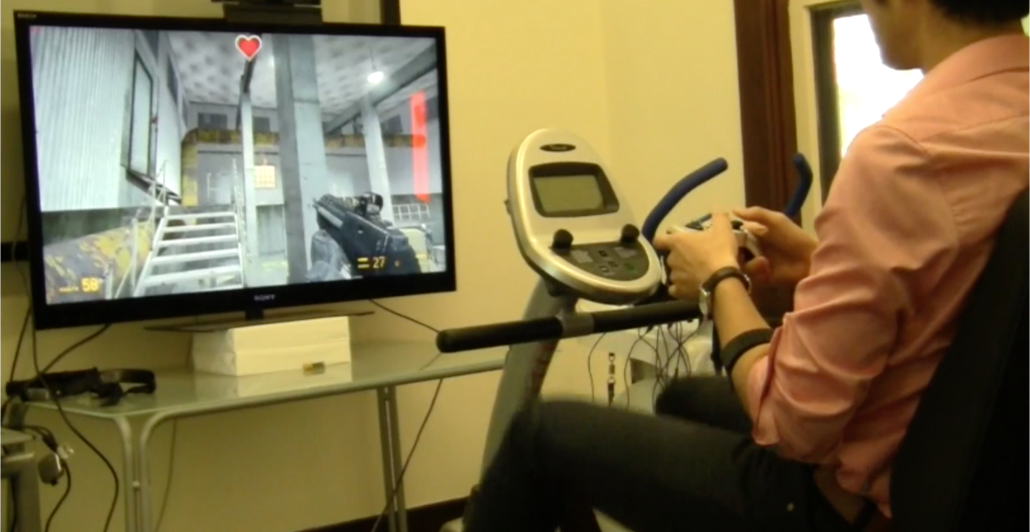
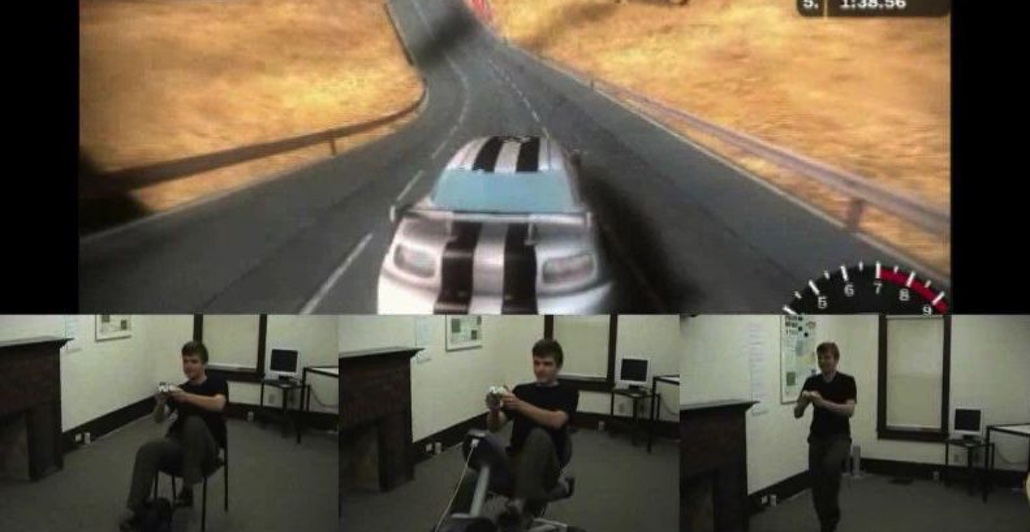
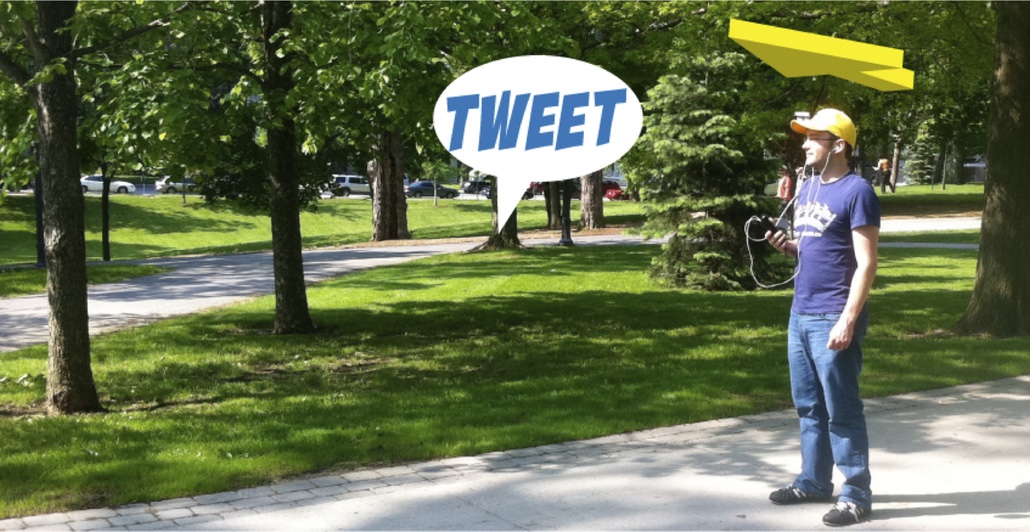
Tad Stach was recently interviewed by the host of the Video Games: Brain Gain or Drain? show on WebTalkRadio.net, Jayne Gakenbach. In his interview, Tad discusses exergame research taking place at the EQUIS lab. You can listen to the full episode online.

GRAND AGM

May 15th, 2011

Banani Roy presents DiscoTech: A Toolkit for Handling User Level Disconnection Problems in Synchronous Groupware

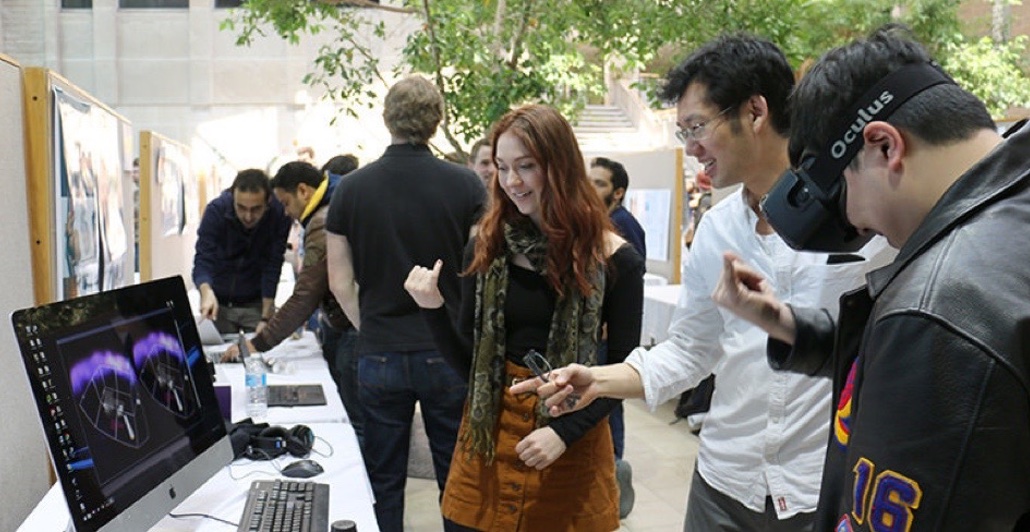
Five members of the EQUIS lab attended the GRAND 2011 Annual General Meeting in Vancouver.  GRAND brings together researchers in graphics, animation and new media from 24 universities from across Canada.  At the conference, Banani Roy presented a poster and gave a work in progress presentation on DiscoTech, a toolkit for disconnection in synchronous groupware.  Ameer Hamza and Hamilton Hernandez also presented and poster and gave a demo on their work on CP Fit  ́n ́ Fun: Health & Social Benefits of Virtual Exercise Games in Adolescents with Cerebral Palsy and Cheryl Savery presented “Timelines for Shared Data in Multiplayer  Games” based on her work on the Janus toolkit.

CISC 877 End of Year Show

April 4th, 2011

Come join us for the end of year show for CISC 877, Engineering Digital Games. The students will be showing off their games, and allowing you to play along.

The show is Friday April 8, 2011, 2:30-4:00 PM, at 141 Collingwood St.

This year’s presentations will be by Jesse Burstyn, Ameer Hamza, Hamilton Hernandez, Tayyab Javed, Aneesh Tarun and Zi Ye.

See you there!

It’s About Time: Confronting Latency in the Development of Groupware Systems

March 28th, 2011

The presence of network latency can lead to usability problems in distributed groupware applications.  Techniques exist that help mitigate the effects of latency, however, as these techniques necessitate the manipulation of state over time, the effort required to implement them can be significant. At the CSCW 2011 conference in Hangzhou, China, we presented timelines, a programming model that allows the explicit treatment of time in groupware applications.

Timelines allow programmers to access and manipulate shared state data in the past, present and future

The Timelines model has been implemented as part of the Janus toolkit.  For more information see:

Balancing Exergames for People of Different Abilities

March 3rd, 2011

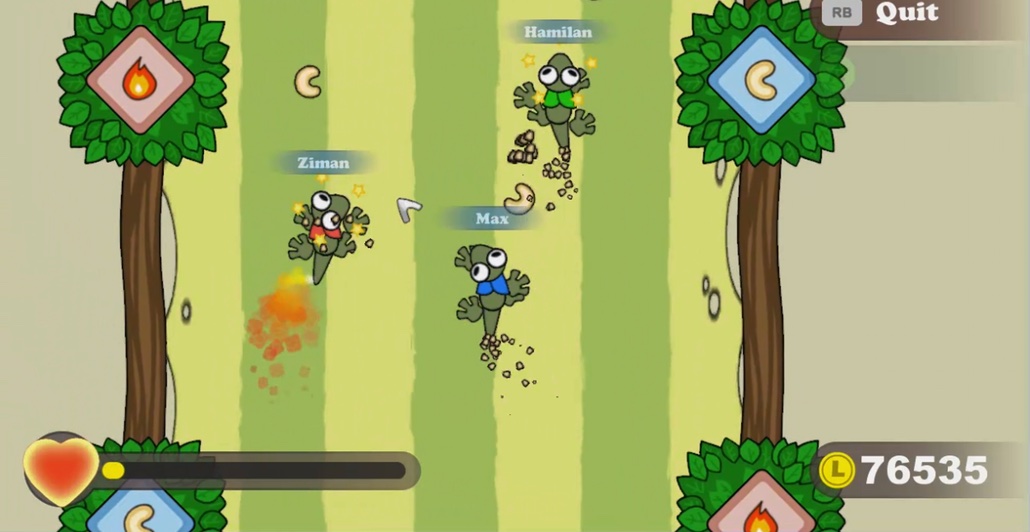
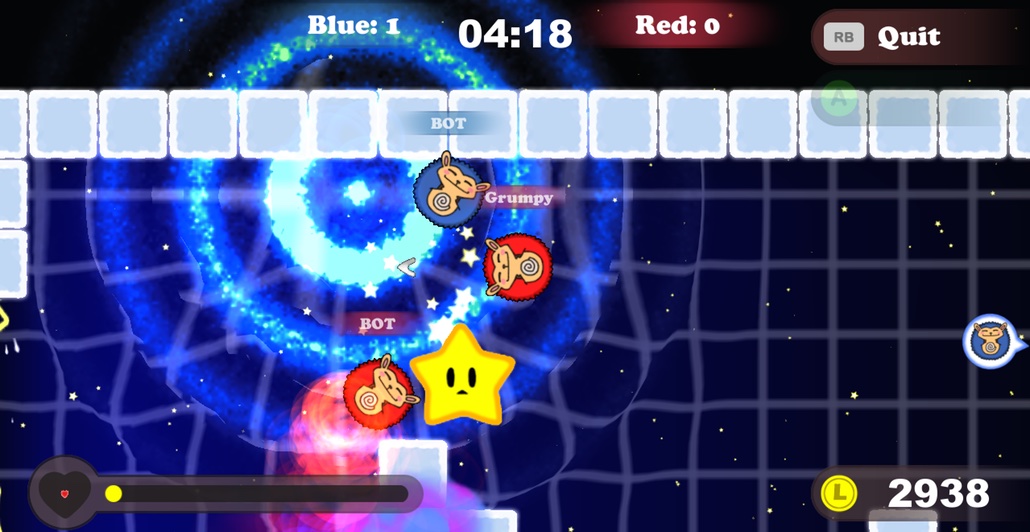
Asymmetric Roles in the Frozen Treasure Hunter Game

One of the most important factors motivating people to participate in physical exercise is having someone else to do it with. But when inactive people start a new sport, it can be difficult for them to find friends who are at a comparable fitness level. People new to sports face the enormously demotivating experience of losing again and again, and of letting down their team.

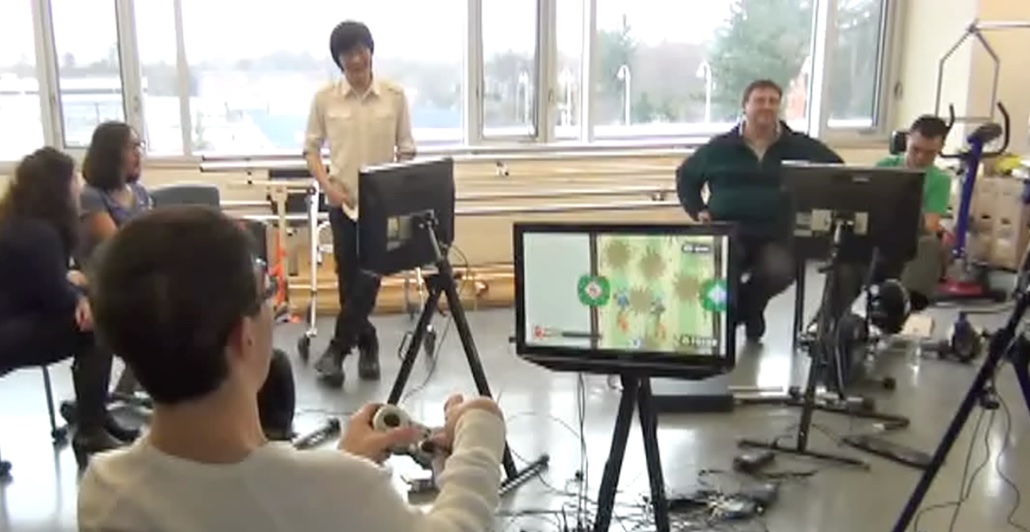
At the Serious Games Summit this week (part of the Game Developers Conference), Tad Stach is showing how multiplayer exergames can address this problem by automatically balancing play, allowing people of different physical abilities to exercise together. Tad is reviewing three approaches for that we have investigated in the EQUIS Lab: providing players with asymmetric roles, adjusting difficulty based on heart rate, and adjusting difficulty through kinesthetic haptic feedback.

For more information, see our work on Computer-Aided Exercise.

Seeing through the Fog at ITS 2010

November 12th, 2010
Christopher Wolfe presents at ITS 2010.

Christopher Wolfe presents at ITS 2010.

Fast and accurate touch detection is critical to the usability of multi-touch surfaces. Many large surfaces are based on optical technologies, such as FTIR or DI, that extract touches from noisy camera input. In our paper at ITS 2010, in Saarbrücken, Germany, we presented a novel algorithm for better noise reduction.  Our technique improves touch recognition over current alternatives, particularly in noisy environments, without additional computational cost.

Our presentation attracted interest from both academic and industrial attendees, and will hopefully contribute to their future works. The foundation of our technique is a novel fast algorithm for applying piecewise-polynomial image filters, such as the quadratic mid-pass filter we use for noise reduction. This algorithm can be easily implemented in many forms (e.g. on a GPU or using a FPGA), so promises improved results and lowered costs across a wide variety of image processing applications.

Human Factors of Consistency Maintenance in Multiplayer Computer Games

November 5th, 2010

Establishing and maintaining a shared and consistent state across two or more players’ computers is an important issue in multiplayer game development.  Game developers cannot always achieve the user experience they would like due to the effects of latency.

The views of two players playing the multiplayer game World of Warcraft. An inconsistent state exists as each player sees their own avatar in front of the other player's avatar.

In gaming, poor consistency can impact the player’s user experience.  Indicators of poor consistency include:

  • Jarring corrections,
  • Inconsistencies among players, and
  • Sluggish response to user input.

For game developers, there is little guidance or tools available to compare the tradeoffs between different  algorithms and to assist in the choice of consistency maintenance techniques.

We present a framework that identifies requirements for consistency maintenance, and we have developed metrics that can be used to quantify the effects of different consistency maintenance strategies on user experience.  Our experiments have shown that these metrics can be used to identify the strengths and weakness of different consistency maintenance techniques, and show that  no one technique is suitable for all situations.

This work will be presented at the GROUP  ‘10 Conference next week.  For more information, please see the paper.

SurfNet Workshop

October 20th, 2010

Amir Sepasi shows off simulation software at SurfNet Workshop

We have just returned from the SurfNet Workshop, held at the University of Calgary. The first day was an internal meeting of the network. Over 40 students presented their research in surface computing, including our own Joey Pape who told about his work on design of games for tabletop surfaces.

On the second day, we made presentations to industry. Over 140 people attended. Joey Pape presented his Tabletop Pandemic game, and Amir Sepasi showed the simulation system that we have created in cooperation with the Army Simulation Centre here in Kingston.

Tabletop Gaming at Ubisoft

October 7th, 2010

Ubisoft Quebec is one of Ubisoft’s four studios in Canada, located in Quebec City. The studio has produced a range of titles since its opening in 2005, including entries to the Rainbow 6 and Prince of Persia series. They are part of the reason that Canada now ranks as the third largest producer of video games in the world.

We went there to demo tabletop gaming. Joey Pape showed off his tabletop Pandemic game, built on Anoto technology using XNA Studio.

Thanks to Stacey Scott for the photo!

Demos at KingCon

September 28th, 2010

On Sept 25 the EQUIS lab took a van-full of demos to KingCon, a local gaming convention. We spent the day advertising the Queen’s University School of Computing, and showing off some of our ongoing work.

We brought two digital tabletops: one rear-projected using diffuse-illumination, and one front-projected using Anoto digital paper. Both performed well, and attracted a lot of positive interest.

The demos for the day were checkers; Robot v Ninjas, a top-down shooter; Asterocks, our classic arcade tech demo; and a mouse emulator for the digital paper. The latter led to some creative doodles in MS Paint and communal exploration of an RPG.